
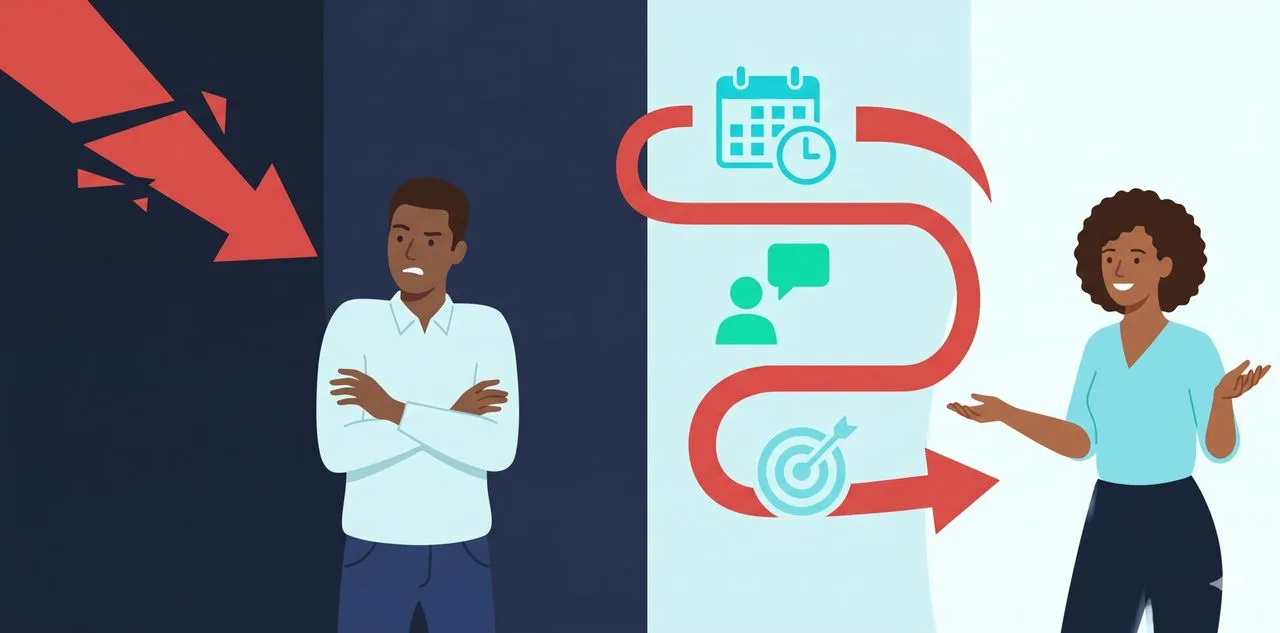
I walk into a company and the department head talks to me about their team. “They don’t listen to what I say”. I ask for an example. “On Monday I told Marco he got the client presentation wrong, and he started defending himself instead of admitting the mistake”.
This is where I understand the problem.
When you tell someone “You got it wrong”, that isn’t communication. It’s a judgement. And what the person hears isn’t the correction: it’s the attack. The brain goes into defence mode. Instead of thinking “How do I improve”, it thinks “How do I protect myself from this criticism”.
Feedback must not be an opinion. It must be information. A feedback signal that lets you act differently next time.
The word says it already.
“Feedback” in Italian translates as retroazione. Like the thermostat that reads the temperature and decides whether to turn the radiators on or off. It’s information that triggers an action.
When the thermostat reads that the temperature is too high, it doesn’t tell the heating system “You were wrong to be on”. It tells it: “The temperature is this, act accordingly”.
Effective feedback works like that.
How do you structure feedback that really works?
It’s simple: SBI. Situation-Behaviour-Impact.
Situation: the specific context where it happened. “On Monday, during the meeting with the client.”
Behaviour: what you actually observed. Not the interpretation. Not the judgement. The fact. “You started explaining the price before showing the value of what we offer.”
Impact: what happened as a result. “The client started discussing the price instead of the value.”
There is no judgement. There is no “You got it wrong”. There is only information: you were in this situation, you did this, this was the result. Next time you can do it differently.
When feedback is structured like this, the person doesn’t defend themselves. They understand. Because you aren’t judging them, you’re telling them what happened and how it affected the result.
The difference is huge.
Try it. Take a situation where you had to give criticism. Structure it as SBI. “In that meeting (situation), when you interrupted the client (behaviour), they stopped listening (impact).”
Next time, watch how the team responds. Not with defence, but with listening. Because at last it isn’t an attack: it’s information.
And people act on information, not on fear.
Try structuring the next feedback you have to give as SBI. What changes in the response you get?