
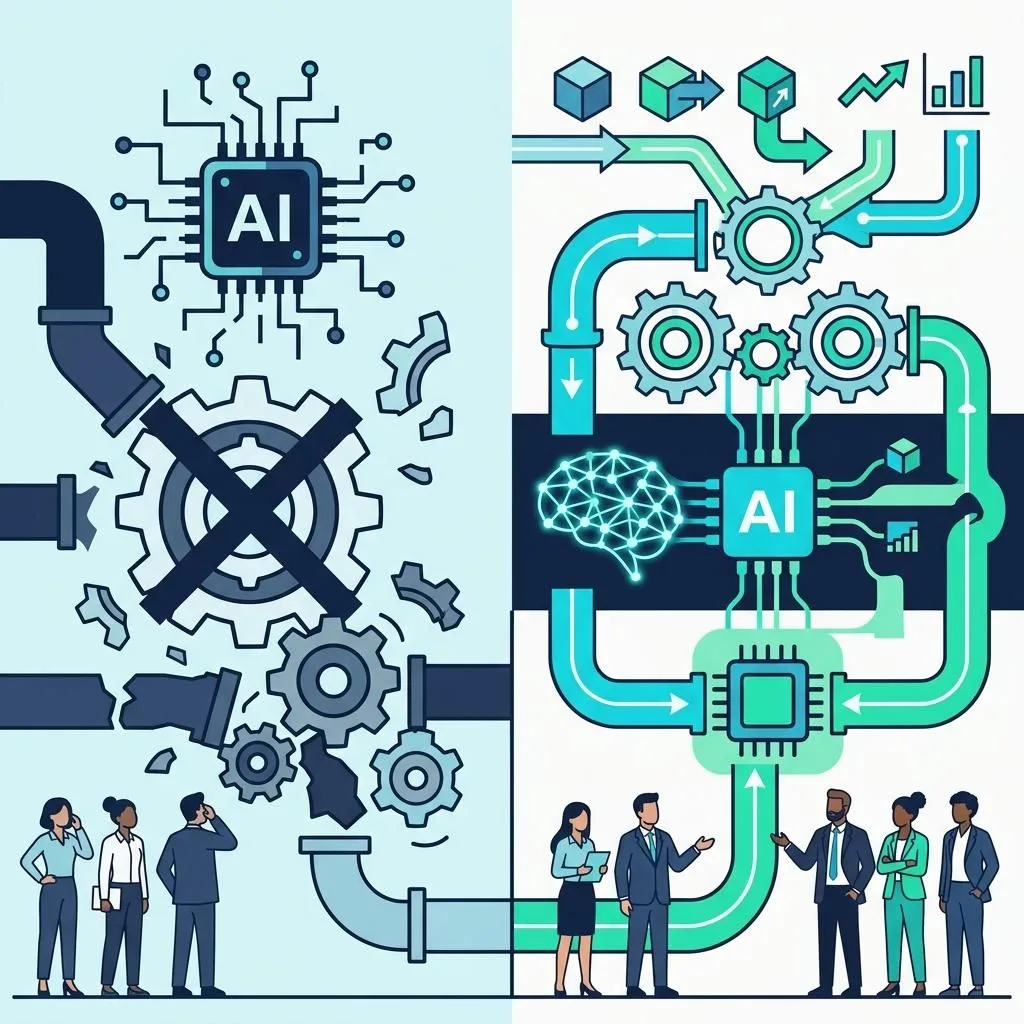
Why AI alone solves nothing
When I walk into a company and see owners excited about AI, the first question I ask isn’t “which tools do you use?”. It’s “how does this process work before AI?”.
Because there is a very common mistake: thinking AI can compensate for a disorganised flow of work. It doesn’t work that way.
The process matters more than the tool
Imagine an assembly line where every operator works with different criteria, the input data changes every day and nobody knows who decides what. Now put AI into that process.
Result: the same chaos, only faster. More errors produced in less time.
AI amplifies whatever it finds: if it finds order, it produces efficiency; if it finds chaos, it produces multiplied chaos.
What I’ve seen in the field
In a technical services company, the team had implemented an AI chatbot to handle customer requests. It seemed like a good idea. The problem was that nobody had ever defined who had to answer what, what the priorities were, which information was confidential.
After six months the chatbot was answering inconsistently, customers were confused, the team was correcting by hand. It wasn’t an AI problem. It was a problem of the process that existed before.
What to do before introducing any AI tool
Before any AI implementation, there is groundwork that can’t be skipped:
Map the real flow of work — not the one you think exists, the one that really exists. Identify where information gets lost, where activities are duplicated. Establish who is responsible for what, with written, understandable rules.
Only then does it make sense to introduce an AI tool.
The right question
It isn’t “which AI should I use?”. It’s “would this process work well even without AI?”.
If the answer is no, AI isn’t the solution. It’s a step backwards disguised as innovation.
Talk to us
30 minutes. No commitment. Real results.
Tell us where you’re stuck. We’ll tell you if we can help — and how. Right away.